


Partnering on heat risk reduction
Partnering on heat risk reduction
The following resources are designed to facilitate collaboration between health departments, other government agencies, and community partners in using CHaRT to inform community-relevant heat risk reduction strategies. This page is intended to provide examples of real-world applications of CHaRT as teams consider how to apply the tool to their heat risk reduction efforts.
Applying CHaRT to heat risk reduction
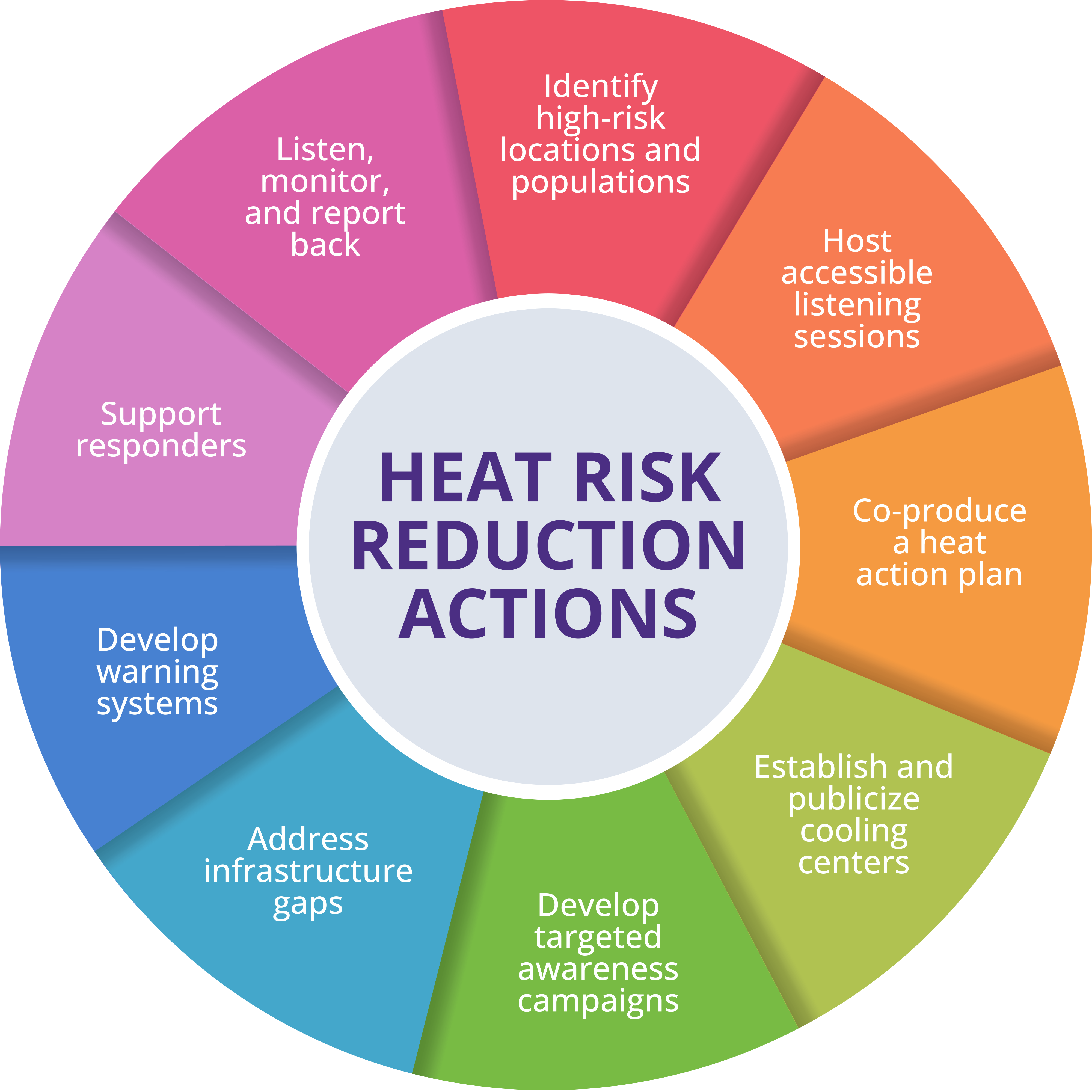
The following diagram outlines examples of heat risk reduction strategies that can be employed to reduce risk within highly-impacted communities. Each example includes a description and a scenario that describes how CHaRT can be used by various partners to identify and implement a strategy. Some of the strategies describe ways that partners can engage community members to strengthen their relevance to the intended audience. A list of resources is provided below for those who wish to learn more about community engagement strategies.
Note that developing a deep partnership requires time, trust, and mutual buy-in. Some organizations may not have the interest or capacity to partner with a government agency, and their wishes should be respected.
This is not an exhaustive list of strategies. Certain strategies may be more or less appropriate in a given jurisdiction, depending on the community context.
Tools, examples, and resources
- REACH Community Engagement Toolkit for Climate and Health Research: A compilation of resources including community engagement principles, a community engagement
- Equitable Engagement Toolkit – Oregon: A seven-step framework with practical guides and worksheets to advance inclusive community engagement.
- Heat Action Plan Toolkit – North Carolina DEQ: Templates, communication materials (some available in Spanish), checklists, and sample messaging.
- King County Extreme Heat Mitigation Strategy: A comprehensive, five-year (2024–2029) heat resilience strategy with 20 actionable measures co-developed with frontline communities.
- Public Engagement Report – One Seattle Plan: Example of a report highlighting regional temperature differences due to green space availability.
- National Integrated Heat Health Information System (NIHHIS): A portal for heat mapping, health impact data, and adaptation strategies.


Need help?
Please contact us (heathealth@uw.edu) if you need help using the Community Heat Resilience Tool or interpreting the results for outreach in your community. We're here to help!